
"Even So, Come Lord Jesus"
Sergii Bulgakov on the Coming of Christ

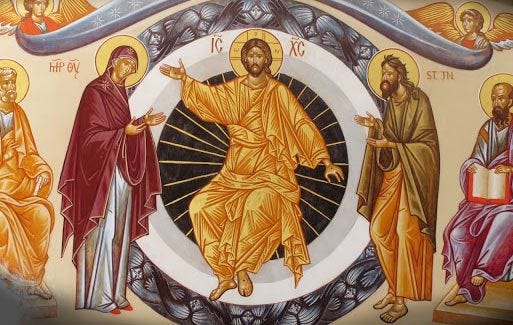
“He will come again to judge the living and the dead.”
Advent is tri-focal. It turns out attention all-at-once to the threefold Appearance of Christ—past, future, and present; historical, eschatological, and mystical. In this season, we not only recall that he has come, and that he will come again, but also that he is coming now, as we make room for him.
For many of us, it is that “future,” eschatological sense that is hardest to take. We take great comfort in news we celebrate at Christmas. And we take great comfort in the promise of his presence to us now, because of Easter and Pentecost. But we are confused and unnerved—even terrified, perhaps—at the thought of his “coming again.”
The Scriptures tell us that our hope is in Christ’s Coming and the liberating judgment it brings about. But how are we to speak of it so that it is hope, and not fear, that comes alive in our heart? First, we must not speak of his “return” in ways that leave the impression that Jesus has left us orphaned in his absence (for two thousand years and counting). His Appearing, the culmination of the working out of the incarnation, happens not in time—as the concluding dot on the timeline of history—but to all times. Sergei Bulgakov (in his commentary on the Apocalypse) has this exactly right, I believe:
The Parousia, then, is not a single but multiple events, taking place during times that are not historical, but apocalyptic. To this we must add that these Parousias apply to the world in all its fullness, i.e. to heaven and earth, the angelic and human, the present world and the afterlife, inasmuch as the separation between them remains until the resurrection of the dead… So the prayer “even so, come” is universal and all-embracing. It does not mark out the Parousia and only the Parousia as the Second Coming but includes every new drawing near by Christ to the world, however it be realized, and consequently includes the whole Apocalypse, with all the appearances of Christ to His saints, even though these are all bound together in His one last advent into the world, the Parousia.
Here we have the broadest and highest spiritual perspective on Christ's drawing near to the world in general, His return into it, and that perspective, depending on how our prayerful attention focused, can be turned equally well to the nearest and still not last manifestation of His advent into the world, as to the last, which includes all those manifestations in itself. So this prayer does not consist of an audaciously insistent petition for the Parousia in particular, but it is received in all the many forms and successive stages of the accomplishment of it. However, it directs our gaze beyond such concretization, focuses our thoughts and turns our love to Christ coming into the world, with the unceasing remembrance of His coming. That remembrance must know no interruption, no relegation as something not contemporary or premature. It is always contemporary and is given for all time by Christ Himself, Who “at every time and at every hour” answers this prayer with the reply: “Behold, I come quickly.”
Too many of us think of the End of All Things as the triumph of one finitude over another, a triumph that perhaps cures all ills and changes our weaknesses into strengths but leaves unchanged the basic conditions of our existence. But the change to come is the transformation of all things—including time, space, and matter—into God’s unconditioned, uncreated ways of being. That change is always “at hand” because it has already been accomplished in Jesus and by the very nature of his being-with-us his fulness is happening to us even now. So we pray, “Even so, come Lord Jesus” knowing that that prayer certainly will be conclusively, perfectly answered—in more ways than one!—because it already has been.
Say more about this last clause of this statement: "But the change to come is the transformation of all things—including time, space, and matter—into God’s unconditioned, uncreated ways of being." Transformation into "uncreated ways of being."
I have an ongoing series on Bulgakov's Apocalypse of John on Grail Country, would love to have you join us and talk about this reflection on Even So Come. I'll shoot you an email.