
Abiding Difference
a recent paper on politics, disagreement, and the transgressive purposes of God

I was in Philly last week for the Bible First: Politics conference co-hosted by American Bible Society and the Center for Hebraic Thought. Here is the paper I gave (although I was only able to present bits of it for time’s sake).
Reading Gillian Rose’s conversion in the light of the wisdom of the Book of Ruth, I wanted to make a case for thinking about our deepest disagreements—including those about religion—as being, against every expectation, the work of the God who reconciles all things in Christ.
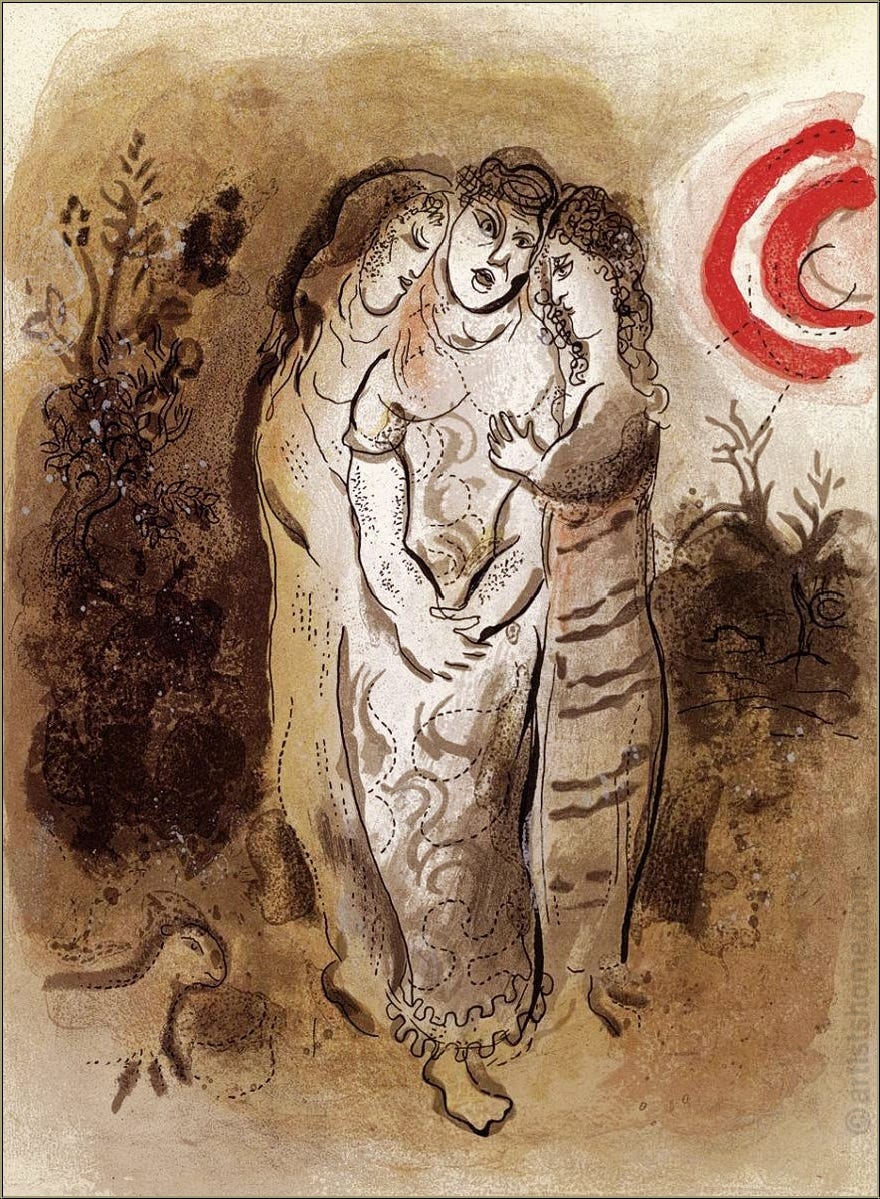
The Cross, the Star, and the Rose Gate:
The Book of Ruth and the Politics of Abiding Difference
Anyone who compares the map of Israel’s travels with the course of my life
will find how exactly they correspond.
—Johann Georg Hamann
But “difference” too is ascribed to God since he is providentially available to all things and becomes all things in all for the salvation of them all.
—Dionysius the Areopagite
I .
My aim for this talk—more a hope, really—is to phase open some imaginative space for thinking christologically (and so trinitarianly and ecclesially) about politics and the deepest differences between us, which I think we wrongly assume are what makes politics both necessary and difficult.
I will not make an argument, exactly. I will instead reflect on the wisdom of the story of Ruth and Naomi and the conversion of Jewish philosopher Gillian Rose, asking how what happens with them in their times can help us think not only about the identity-in-difference of Judaism and Christianity here-and-now, but also more broadly about what deep differences are and how they can be embraced and abided, politically and experientially, rather than merely suffered.
Rose is one of the most important of our political thinkers. It is what happens with her, however, that is the better part of her gift to us. Her testimony tells us that what we think we know about difference is wrong because it is not rooted in obedience and awe, in thanksgiving and praise. We are, as a rule, starting with this or that political problem and then asking what Christians should do about it because of what the Bible has to say about it. But we can only begin with doxology, with the surprise of contact with the living God who makes his desire for us known. Only he can reveal what, if anything, we need to say or do or refrain from saying and doing.
One final introductory note: I’ve learned that the phasing open of imagination happens mostly by the alteration of mood, not by the introduction of ideas. So, I will begin with a joke. It contains, in its own way, more or less everything I mean to say.
In their legendary comedy sketch, The Two-Thousand-Year-Old Man, Carl Reiner (as a unsuspecting reporter) asks Mel Brook’s agéd figure what kinds of work he has done in his impossibly long life, a life more than 1800 years longer than anyone else’s. Brooks says he was once a manufacturer, a factory owner. “As soon as religion came in, I was one of the first in that.” What did he make? Jewish stars—stars of David. How were they made? “Well, we didn’t have lathes… I employed six men, see, each with a point. They would run together in the middle of the factory, and in their great speed, they would fuse the thing, creating a star… We would make two a day—because of the many accidents.” Did he ever consider manufacturing anything else? “No. I had an offer once. A fellow came to see me—Simon. He said, ‘We have a new thing, a new item. Looks like a winner. Going to be a best-seller. It’s called a cross.’ I looked at it. I looked at all sides of it. Turned it over, and I said, ‘It’s simple. It’s too simple.’ I didn’t know it would be such a hit. I said I’m sorry, I’m too busy.” Does he regret turning down the business? Oh indeed. “I could’ve fired four men. Two men run together—bang! You’ve got a cross.” He could’ve made a hundred dollars, he says. If only he had taken the business.
Selah.
II.
“There is no early or late in the Torah” (Mekhilta Shirata 7). This rabbinic principle is also true, in its own way, of the Christian canon. Although the story of Ruth appears in the middle, it is, spiritually, a culmination of the maturation of Israel’s witness as the people of God for the sake of the world.
“Wherever you find the greatness of the Holy One, Blessed be He, there you will find His humility” (Megillah 31a). The reverse is also true. Because all humility is his humility and humility is the glue that holds all things together. Ruth is a humble work. That is its power. “A quiet polemic,” Alter calls it, “beguiling,” and “charming from beginning to end.” The question is, What does it so beguilingly and charmingly contest?
“Had the Torah not been given, the Song of Songs would have sufficed to guide the world” (Rabbi Akiba). The same could be said of Ruth. A drama without conflict, without antagonists (except perhaps for God!), it contrasts not the righteous with the wicked but the exemplary with the merely prudent. It is a story of covenantal conviviality (to use Illich’s word) in a time of tragic disorder, a discreet but for that reason all the more effective testimony against the violent enforcement of divine order—a violence seen, and seen to fail, in Ezra and Nehemiah.
Ellen Davis calls the story the “still small voice” after Judges’ wind, earthquake, and fire. It is a sign of contradiction, nonetheless. A word spoken against a spirit of rivalry and control. It is powerful precisely because it is weak. A soft word that turns away wrath. Not a fire but a fuller’s soap. Or, to change the image yet again, it is a gentle washing, working out the stain of violence without doing violence, without rending or tearing the garment. That is its unique charism, what makes it the crown jewel of the Scriptures. If the Song of Songs is a fiery, mystic vision of divine eros, Ruth is a small, modest icon of human agape.
You would not know it from the way most of us have read Ruth, much less from the way that we live together or talk about our shared life, but there is a way of disagreeing, even a way of separating, that does not demand the making of enemies or their ostracization, much less their injury or violation. That is because there are differences that are of God’s making, of providential design. For Christians, then, Ruth is not only a picture of what was once possible but also a training in the spirit of Jesus, the spirit by which the church is made faithful in every present. Thanks to the Spirit, this text imparts to us the meekness and poverty of spirit by which the Father’s peaceable kingdom makes itself known. “What will be, can be.” Ruth reminds us why that must be so.
III.
“In the days when the judges ruled, there was a famine in the land…” (Ruth 1.1). That is how the story begins. Nothing explicit is said about what caused this famine or why it has come. No one is blamed for it. God is not said to be its author. In the lines that follow, we are told in short order of a whole series of disasters. Naomi’s family escape the famine in Judah, fleeing to Moab, but something worse befalls them there. Her husband dies, and then, ten years later, her sons die, too—apparently, both at once. Again, nothing is said about how their lives were lost or taken. It seems clear they are still young, and the fact that they die at the same time suggests violence. The narrative holds back all such details. All that matters is that they have died, and that Naomi, “the woman,” is bereaved, reduced to her beginnings. She is a new Eve, living the original nightmare again. Her Adam has died, through no fault of her own, and so have her Cain and her Abel. Moab has been a respite, but it is not Eden.
By the end of the story, we come to a wedding—exactly as at the end of the first “week” in Genesis. That is Naomi’s doing, ultimately. From the moment they return to Bethlehem, she works to save her daughter-in-law and to redeem her family’s name. Ultimately, Boaz acts decisively and publicly—at the gate, in the presence of witnesses, in a binding liturgy: “Today you are witnesses…” (Ruth 4:9–10). He is clear that he is taking Ruth the Moabite, “the wife of Mahlon,” so that, against all expectations, she is both made a woman of Israel and the dead man’s line is not cut off. Precisely so, Boaz cares for the living by caring for the dead and secures the dead by securing the living.
The community answers him with one voice, sealing the act with blessing, and speaking Ruth into their future, imagining her as someday holding a place of honor alongside their matriarchs:
“We are witnesses. May the Lord make the woman… like Rachel and Leah” (Ruth 4.11). And they go further still: “through the children that the Lord will give you by this young woman, may your house be like the house of Perez, whom Tamar bore to Judah” (Ruth 4.12).
With these words, forged in a shared remembering, they show that they know Israel’s life has always been carried forward through irregular mercies, through scandalous women whose lives and stories proved anything but disgraceful. Just so, their words become merciful and create a new regularity. They welcome Ruth, therefore, not because they do not know who she is or where she is from but because they know, at last, who they are—a people kept alive by being welcomed, and by learning, in their turn, to welcome. They have remembered that their God is the God who calls those things that are not as though they were, the God who raises the dead, so that their present, exactly like their past and their future, will be given and received, not won and defended. They know that the people of God have never been and can never be made whole by violence, never sustained through fear by fear. That the fabric of reality is mended not by bloodshed but by the sharing of bread and wine, the outpouring of incense.
Ruth’s ending does not abolish tragedy. Nothing has changed, it seems, in the tragic conditions in which the story has unfolded. The world has not been made safe. Indeed, it is if anything more dangerous and uncontrollable than it had been before. The midrashic tradition finds an almost endless variety of ways of reminding readers that this is no fairy tale. According to Ruth Rabbah (4.4), Ruth was so beautiful, so desirable to look upon, that anyone who saw her would involuntarily ejaculate. Boaz, however, was sterile, and so could not give Naomi an heir—until her prayer and blessing healed him (6.4). According to Ruth Zuta (4.13), a 13th century midrashic counter to the much older and more expansive Ruth Rabbah, Boaz dies on his wedding night, and Ruth and Naomi are widowed together. That same text suggests that until that point, the Israelite had been suspicious of the Moabite—her morality, the sincerity of her conversion.
These rabbinic speculations and ponderings aside, the story, taken on its own terms, offers no “happy ending.” It does, however, show how despite all that has happened and all that may still befall them, an outsider, one unclean, can be received by the faithful in a way that establishes justice and so makes peace between city, soul, and Spirit. Ruth becomes a Jew, as Abraham did, not by birth but by the word of God, through grace and faithfulness alone. Precisely so, she becomes a renewer of the covenant given to him, another living proof that the life of the people of God is always necessarily as welcoming as the life of their God.
IV.
Gillian Rose was born into a secular Jewish family in England in 1947, and died there in 1995 from complications of ovarian cancer—baptized on her deathbed by Simon Barrington-Ward, the Anglican bishop of Coventry and her longtime friend. At sixteen, Gillian changed her name from Stone, the name of her forbidding father, to Rose, the name of her loving stepfather; and that name change, in her words, “served as my bat mitzvah, my confirmation as daughter of the law.”
Rose talked often of “difficulty”—especially the “difficulty of thinking in the wake of disaster,” which she believed required saying No both to the “fantasy of mending the world,” the childish impatience with the unfixableness of things, and the temptations of “everlasting melancholia,” the luxury of making a fetish of anger at injustice, the refusal of any newness on the grounds that newness is ever needed in the first place.[1] That is appropriate, because her baptism as an Anglican, received only an hour and a half before she died, is itself difficult, participating in and serving as a sign of the “scandal of particularity” and “the sign of contradiction” Jesus himself is.
In her last notebooks, Rose records bits of an exchange with David Robinson, a Church of England chaplain. “Holding his warm plump hand” she tells him “I am both Jewish and Christian… I find both the Jewish affirmation of one God and the Christian Trinity, essential, especially the Holy Spirit.” Robinson predicts she will be baptized, but her allegiance, she tells him, is “equally deep to Judaism,” preventing her conversion. Ye he insists, leaving her with a parting gift: “Next year in Jerusalem”—a line sung at the end of each Passover Seder.[2]
The next day, things change. After a surprise midmorning visit from Bishop Simon, she asks to meet with a rabbi, and writes a few lines, perhaps for a poem:
God is not nice
God is not Uncle
God is an earthquake
Later that afternoon, she makes an entry in the notebook that suggests her mind has changed: “This is the ‘leap of faith’ (SK). I shall not lose my Judaism, but gain that more deeply, too.”[3] As Robert Lucas Scott observes, “only a day before, Judaism had appeared as the obstacle to her Christianity. Here, though, they are taken to reinforce one another. Rose is Jewish and she is Christian, and for that reason, she argues, she gains each all the more. She is forsaken, she shall not want; she shall not want, she is forsaken.”[4]
It seems, judging from her notes, that something Robinson said about another Jewish philosopher who, famously, and surprisingly, did not convert had somehow convinced Rose of what she herself had to do: “Simone Weil was like an angelus bell: she called others into the Church but stayed outside herself.” She notes another of the chaplain’s lines: “We too are other than we imagine ourselves to be and to know this is forgiveness.” Then, cryptically, she adds her own estimation of what is happening: “apokatastasis: all things coming together.”[5]
Reading Rose’s final notebooks makes me wonder what Ruth would have written if she had kept record of her conversion. Or what would have happened if, impossibly, the two had addressed each other through an exchange of letters. Certainly, they could have spoken long of grief. For Rose, the whole history of modern philosophy, as well as the whole history of modernity philosophers philosophize about, is a history of “failed efforts to mourn.”[6] And whatever Ruth herself might have said, the story told of her and Naomi has much to say about how mourning comes to be, and becomes hope.
In her inaugural lecture, “Athens and Jerusalem: a Tale of Three Cities,” Rose turns, characteristically, from a tired theoretical opposition to a lived predicament. She names three German Jewish women—Rahel Varnhagen, Rosa Luxemburg, Hannah Arendt—who had, each in her own way, “exposed the inequality and insufficiency” of the political arrangements of her day, but “without retreating to any phantasy” of “the community” as exclusive. Because “each staked the risks of identity without any security of identity.” They had been able to live for what Rose calls the third city—neither Athens nor Jerusalem, which are ultimately phantastic abstractions, consoling fictions. She observes that each of these women had at some point entered Berlin, and says she likes to think they entered through, and often returned to, the Rosenthaler gate—“one of three legal entry-points into the city for Jews in the eighteenth century”—to mourn and to be mourned. This is her name, she says, Rose, a name she had taken for herself, and one her family had earlier taken to make possible their entry into German civil society. And with that image and the history it carries she “signs and concludes” the lecture.[7]
That move invites us to think of Rose and her history, received from her people, as a gate, an entry point, a protected access to the third city—that is, to a livable politics, one that does not have to resort to violence or withdrawal. And that, of course, cannot help but recall the gate where Boaz and Bethlehem blessed Ruth, welcoming her as a new Rachel, not weeping but joyous, and a new Leah. This is the doubling made possible by the difference God makes, the holding together in doxological practice of what in theory must be torn apart.
Rose’s final notebook entry, made on December 5, four days before her passing, is, even more than most other entries, fragmentary—a loose bundle of scriptural and liturgical sheaves, gleanings gathered for the end of her day. They locate her life inside Scriptural time, within the terrain of the act of God. She notes that she must find references for the Maccabean Mother, the Greeks who come to Philip, saying, “Sir, we wish to see Jesus,” and St Luke’s story of Zacchaeus—the “tiny man” who climbs the sycamore tree to spy the Lord as he passes by. She lists prayer books, and the baptismal renunciations: “I turn to Christ… I repent of my sin… I renounce… evil.” Lastly, she records two references to her own previous thought: “despairing rationalism without reason” and the ascetical injunction of St Silouan the Athonite, which had been the epigraph for Love’s Work: “Keep your mind in hell and despair not.”[8]
What do these fragments mean in relation to her conversion? Scott takes them to be a sign of purposefully unresolved internal conflict.
“Faith,” for Rose, names not only this latter affirmation—the faith that “the Lord is my shepherd, I shall not want”—but the capacity to hold that affirmation with its other: “you have forsaken me.” This is what faith means for Rose… As she wrote in her final essay, with the most anguished ambivalence, “Christ is all but coming”—where “all but” can mean “almost,” suggesting the imminence of salvation, but also “everything except”: a double entendre suggesting a theological and eschatological tension, not simple resolution.[9]
Perhaps. But these injunctions seem more to have been a statement of surrender and release, a signing-off on letting the work of God have its way in her life, whatever the costs. In her memoir, she rejects the inhumanity of what she calls a “post-Judaic, New Age Buddhism,” deciding instead for an older, simpler wisdom, one that accepts the basic limits of being human, body and soul: “The tradition is far kinder in its understanding that to live, to love, is to be failed, to forgive, to have failed, to be forgiven, for ever and ever…” For that reason, therefore, “to grow in love-ability is to accept the boundaries of oneself and others, which remaining vulnerable, woundable, around the bounds. Acknowledgement of conditionality is the only unconditionality of human love.”[10]
Ultimately, Rose found Christ to be more than an idea, an aporia in thought. She came to see that she had to acknowledge him—as a friend, a living, lively companion and guide, and to accept that it was his unconditionality that determined all her conditions, including her dying. So, on her deathbed, Bishop Simon baptized and confirmed her in the faith. Unable to speak, she responded to his questions—“Do you turn to Christ?” “Do you repent of all your sins?” “Do you renounce evil?”—by squeezing his hand.
Later, in a Lenten sermon preached at Little St Mary’s Church, Cambridge, the bishop quoted from a letter Rose had written to one of her doctors only days before she passed:
You know me to be a Jew. I am also a Trinitarian… However, while I feel held by God and the Holy Spirit, like many Jews I have a difficulty with Christ, “to the Jews a stumbling block.” As a result of this week’s experience I have gained Christ. For Christ is a stumbling block, but once you touch the hem of his robe with faith, you are healed. I shall be thanking God for this insight and gift.[11]
Whatever else we make of them, these are words not of resignation but of glad relief, of deep delight. For a long time, Ward tells us, Rose had “feared a Christian romanticism or sentimentality which contrasted grace with law and let us off the hook far too easily, offering only ‘cheap grace…” But something changed in her final days:
During that week she seemed to have arrived at an amazing equilibrium. She had moved into the forgiveness on the far side of repentance, from mere eros into an agape love she had never quite acknowledged before. She wanted, as she had always said, to live in “joyful mourning” (a favourite phrase of hers, from the 6th century John Climacus, “Abbot” of St Catherine’s, Mount Sinai). Gillian was now both grave and yet also elated.[12]
Rose lived something like a reversal of Ruth’s conversion and homecoming. That such a thing might happen should not surprise us, not if we are mindful readers of the Scriptures. Again and again in these texts, the outsider proves to be more righteous than the insider. Again and again, the decisive work is the work not of judgment but of mercy. Or, better, the work of the mercy of judgment and the judgment of mercy.
In her work, Rose had warned against any and all forms of political utopianism as well as what she came to call the “unrevealed religion” that controls our lives. Finally, to her own great surprise, she realized that what she wanted and needed was atonement. And that, she realized, cannot be built or discovered; it has to be taken as it comes. How else would it be God’s doing?
Ruth is “triply disqualified” and yet becomes, in Israel’s memory, a bearer of Israel’s future because of how she clings to Naomi. Rose, for her part, goes the way of Orpah—but also does not let go of Naomi. She takes her Judaism with her. In the decisive moment, she will not go on, even when death is at her doorstep, in any way that requires an unfaithful remembrance of the past, her own or her people’s. She means to be true to Judaism in some sense by being baptized and confirmed in the Christian faith. Why would we not believe her when she claims she will gain Judaism more deeply precisely because she has gained Christ? That her conversion was not an abandonment but an abiding? Answering those questions tells us what we actually believe, not only about the nature of politics in the City of Cain but also about the ways of God.
V.
In the second installment of my Christological trilogy, The Fire and the Cloud, the final, culminating chapter, entitled “Homecoming,” opens with three epigraphs. The first is from Scripture: “Her ways are ways of pleasantness, and all her paths are peace” (Prov. 3:17). The second is from André Neher: “The end, in the Bible, is never simply happy. It transcends happiness through involving unhappiness” And the last is from Gillian Rose: “Friendship is relational, not differential, because it is always pervaded with meanings neither party intends.”[13]
We know how to think difference only by seeing Christ as the one who reconciles all good opposites and overcomes all that is opposed to the Father. Seeing him, we know, that difference is God’s, essentially and economically. Not all differences are God’s, of course. But difference as such is. As Dionysius (Divine Names 9) says:
But “difference” too is ascribed to God since he is providentially available to all things and becomes all things in all for the salvation of them all. Yet at the same time he remains within himself and in his one unceasing activity he never abandons his own true identity. With unswerving power he gives himself outward for the sake of the divinization of those who are returned to him.
That difference between God and humanity, the difference that is also a unity because it belongs to God’s own being, shows up in history as the difference within Israel between the church and the synagogue. Franz Rosenzweig sees that difference in the differing geometries of the cross of Jesus and the shield of David, the star of redemption. The cross, he says, extends ad infinitum, its beams raying out from its heart in all directions. The star, however, in-tends, enfolds, uniting “all the rays into the heart of the fire.” Those differences make all the difference, he believes, so that Jews are bound, pulled inward by the centripetal force of the star, consumed by the fire at its heart, while Christians are carried outward along the centrifugal forces of the explosion of that fire in what happens with Jesus of Nazareth and his co-conspirators.
The Christian consciousness, absorbed entirely in faith, pushes toward the beginning of the way, to the first Christian, to the Crucified One, as the Jewish consciousness, gathered entirely in hope, toward the man of the last days, to David’s royal shoot… Rooting into the deepest Self, this has been the secret of the eternity of the People. Expansion through all that is outside—this is the secret of the eternity of the Way.[14]
He is right, of course. To be claimed by Christ is to find ourselves moved, borne along we know not how, taken where do not want to go, hands tied. But in this present evil age, this time between what is and what shall be, and given the detours that have separated the people of God as well as the total unmanageability of the transgressive, redemptive God whose thoughts are not ours and whose ways break all our calculations, surely at least some of us will be surprised by what is required of us!
Ruth is both cross and star. And both appear on Rose’s tombstone. They together are a sign to us. Especially those of us who want to draw and enforce the line Ezra and Nehemiah thought would save their world. We can be divided by difference, yes. But we can also aspire to abide it—even when it calls for alteration in what we have understood to be for us the definitive form of life.
Needless to say, there are real and imagined differences, good and bad and indifferent differences, differences that make no difference and differences that make all the difference. Whatever we might wish to be the case, there are differences that cannot be resolved or overcome—because God wills them! These differences are for us truly irreconcilable. The wonder is, it is precisely for that reason that they work reconciliation in us, true us to God, make us Christ’s co-conspiratorial co-reconcilers. That is why God wills them! We must do more than suffer such differences. We must abide them, take them as the graces they are—as Ruth and Naomi did, as Rose and Rosenzweig did. Then we may become a gate, or perhaps a bell.
[1] Maya Krishnan, “The Risk of the Universal: The Philosophy of Gillian Rose,” The Point Mag (June 3, 2024); available online: https://thepointmag.com/politics/the-risk-of-the-universal/.
[2] Gillian Rose, “The Final Notebooks of Gillian Rose,” Women: A Cultural Review, 9:1 (1998), pp. 6-18 (p. 7).
[3] Rose, “The Final Notebooks,” p. 9.
[4] Robert Lucas Scott, “Ending in the Middle: On Gillian Rose’s Death,” Parapraxis; available online: https://www.parapraxismagazine.com/articles/ending-in-the-middle.
[5] Rose, “The Final Notebooks,” p. 10.
[6] Krishnan, “The Risk of the Universal: The Philosophy of Gillian Rose,” n.p.
[7] Rose, Mourning Becomes the Law, pp. 15-39.
[8] Rose, “The Final Notebooks,” p. 18.
[9] Scott, “Ending in the Middle: On Gillian Rose’s Death,” n.p.
[10] Gillian Rose, Love’s Work (London: Chatto & Windus, 1995), pp. 98–99.
[11] Graham Kings and Ian Randall (eds.), Exchange of Gifts: The Vision of Simon Barrington-Ward (Edinburgh: Ekklesia, 2023), pp. 195-202.
[12] Kings and Randall, Exchange of Gifts, pp. 195-202.
[13] Chris EW Green The Fire and the Cloud: A Biblical Christology (Waco, TX: Baylor University Press, 2024), p. 281.
[14] Rosenzweig, Star of Redemption, p. 368.
What an amazing read…amazing story of Rose…amazing analogies to Ruth, Naomi, Boaz…amazing insights of the Star of David and the Cross of Jesus…and so much to ponder on how to live, to abide in our differences….it’s a beautiful read…it’s so deep and mysterious…God has gifted you with a beautiful heart and mind….Blessings to you!
Another comment….the statement I have copied and pasted below is such a beautiful and stark reminders…and probably is how we learn to experience “abiding differences” is with developing a posture of doxology in our being…so beautiful!
We are, as a rule, starting with this or that political problem and then asking what Christians should do about it because of what the Bible has to say about it. But we can only begin with doxology, with the surprise of contact with the living God who makes his desire for us known. Only he can reveal what, if anything, we need to say or do or refrain from saying and doing.
One other comment that came to my mind when it was shared by one of the “Rabbi’s” about how beautiful Ruth was…that if anyone were to encounter Ruth, they would ‘involuntarily ejaculate’…..what came to my mind, is how I wish and desire that I would begin experiencing actions of love coming out of me towards others, as ‘involuntary love’:)!! Blessings to you!